

“A November bouquet†depicts Cornelia Phillips Spencer’s revered goldenrod with blue asters, black berries of catbrier, fruit of chokeberry and turning leaves of strawberry bush and sweetgum. Photo of original painting by Ken Moore
By Ken Moore
Flora Columnist
I’m returning to the words and paintings of Cornelia Phillips Spencer, who took a closer look at our local flora 139 years ago.
“November bouquet” is an appropriate accompaniment for Mrs. Spencer’s description. This particular fall wildflower bouquet, initialed J.J. S., is the work of Mrs. Spencer’s daughter, June James Spencer, who later married James Lee Love, assistant professor of mathematics at UNC.
A note by James Love in the Spencer papers of the Southern Historical Collection tells that, at her mother’s encouragement, June had become a fine botanical artist and in turn encouraged her mother, who is credited with most of the flower portraits in the collection.
In “Late summer woods,†N.C. Presbyterian, Oct. 8, 1873, Cornelia Phillips Spencer extols the “weeds.â€
“If one should delight in weeds, now is the time. … It is often a little painful to find that in the late summer we must class among weeds many a plant, whose pretty flower early in the season seemed a paragon of delicacy; – now, the coarse and rampant growth is undeniably plebian and weed-sy. I fear that my summer favorite, the goldenrod, runs some risk of such deterioration. … The Vernonias, –commonly called ironweeds, – are a beautiful companion to goldenrods, their clear and brilliant purple being in the best possible contrast … the flowers, taken singly, or the heads with their singularly pretty involucres, would be ranked among our very daintiest darlings.â€
“A coarse leaf and a coarse stem and a way or growing along the road side has given these beauties the name of weed. The asters are very conspicuous now, from pure white through all the shades of lavender and purple. They too look charmingly with the goldenrods. … The sunflowers and their cousins the Rudbeckias are a little flaunting, and should make the back-ground of a bouquet. Most of our fall flowers are rather strong growers and high colored.â€

In the late fall Cornelia Phillips Spencer found blue asters still in flower with the crimson foliage of Virginia creeper. Photo of original painting by Ken Moore
Later that same year Cornelia Spencer wrote “A journey in October†for the N.C. Presbyterian, Oct. 29, 1873.
“With all possible, all due admiration for the gorgeous assemblage of colors in later October, I must own to a great love for our landscapes while the greens are yet predominant, and the crimsons and yellows and browns are only the touches, – ‘Autumn laying here and there, A fiery finger on the trees.’â€
“There is more leisure for observation and for enjoyment and full appreciation of the effects of color then, than when the whole forest is a mass of glowing hues. But what splendor of changing beauty the Creator has ordered to be shed around our daily life from the first of October to the close of November, when the last rich shades of brown are lost in the purple haze of Indian summer. People ought to be much abroad these days, and should take their children out and be never tired of calling their attention to the glories of the scene.â€
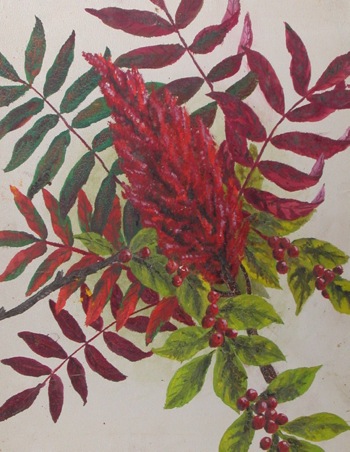
Mrs. Spencer extolled the colors of sumac leaves here depicted with stem of deciduous holly. Photo of original painting by Ken Moore
Cornelia Phillips Spencer advises us well!
Email Ken Moore at flora@carrborocitizen.com. Find previous Ken Moore Citizen columns at The Annotated Flora.
10 things I love about gingko trees

Ginkgo trees have fantastic autumn foliage. Photo by Peter Del Tredici
By Carol Ann McCormick
Guest Flora Columnist
1. They’re old – really old. The earliest gingko trees were found in the Middle Jurassic (180 million years ago), and the seeds were probably dispersed by carrion-eating dinosaurs. Since the Jurassic there have been about a dozen species, but only Ginkgo biloba is alive today, and since we are sadly lacking in dinosaurs, it now depends on humans for dispersal.
2. Ginkgo biloba is more closely related to pines than to maples and oaks. (For botany wonks, it is a gymnosperm in its own division, Ginkgophyta.) An individual tree is either male or female, and depends on the wind, not insects, for pollination.
3. An individual tree can live 1,500 years! Ginkgo biloba is native to China and the oldest trees are found growing near temples. Monks did not ascribe any religious significance to the trees, but appreciated them for their longevity, beautiful leaves and edible nuts.

Ginkgo fruit and green leaves. Photo by Laura Cotterman
4. Ginkgo seeds have a squishy outside (“sarcotesta†for those studying for the SAT) containing hexanoic and butanoic acids, so they smell like rotten flesh or vomit (remember the carrion-eating dinosaurs in 1?). However, the interior “nut†is not stinky and is used in Asian cuisine. Margo MacIntyre, curator of the Coker Arboretum, reports that the seeds are avidly harvested by visitors. (She also asks that you not leave a pile of sarcotesta right by the bench where other people want to sit and enjoy the ginkgo foliage.)
5. Ginkgo trees have beautiful leaves – simple and elegant in form, leathery in texture. Ginkgo adiantoides, an extinct species native to North America, had leaves remarkably similar to Ginkgo biloba.
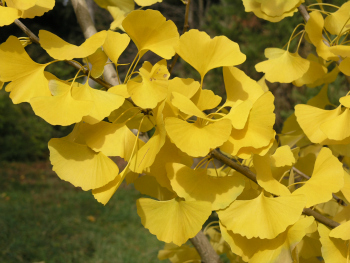
Golden ginkgo. Photo by Peter Del Tredici
7. Despite cultivation for 200-plus years in America, there is scant evidence of gingko naturalizing and becoming a weed.
8. Ginkgo trees have fantastic autumn foliage. In mid-October an entire tree will go from green to gold in a day or two. In mid-November, the tree will go from all gold to bare in just a day or two.
9. The University of New Hampshire has annual contests to Pick the Day the Ginkgo Leaves Fall (winner gets pizza) and Catch a Ginkgo Leaf (winners get good luck for the year). “They’re actually quite difficult to catch,†says UNH student Mary Dellenbaugh. “Because the leaves are fan-shaped, their falling pattern is very erratic. As soon as you think you have it in your hand, it darts out of reach.â€

Ginkgo adiantoides fossil. Photo by Patricia Gensel
10. Go find a ginkgo! There are two mature trees (one male, one female) along the north edge of the lawn in Coker Arboretum on the UNC campus. Between Hanes Art Center and Kenan Music Hall there is a new allé of 20 trees, and UNC Forester Tom Bythell promises, “In a decade when these trees are mature, this will be the place to be when the leaves turn gold.â€
Email Ken Moore at flora@carrborocitizen.com. Find previous Ken Moore Citizen columns at The Annotated Flora.
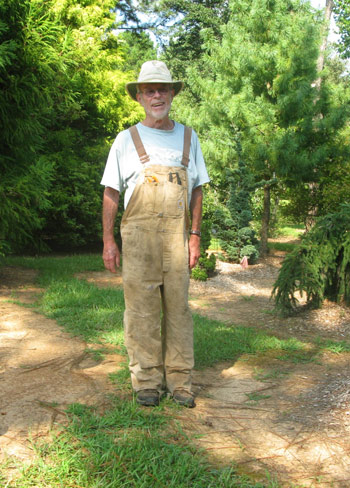
Charlie Keith will be happy to greet visitors to his arboretum. Photo by David Swanson
Flora Columnist
Many years ago I learned that “plant nut†is an endearing term for any man or woman who is truly passionate about plants. “Plant nuts†want to grow and know everything about any plant that catches their fancy.
Chapel Hill and Carrboro have lots of plant nuts, and you’d be surprised at what’s out in the county hereabouts where there is room to grow any and everything.
One of these plant nuts is Dr. Charlie Keith. There will be a rare opportunity to visit his plant-nut paradise, Keith Arboretum, on Sunday, Oct. 21 from 1 to 5 p.m. Though Charlie’s personal arboretum has been visited by horticultural and botanical societies over the past decade or two, there has never been an opportunity for the general gardening public to visit.
Local plant nuts who have already visited will jump at this opportunity for another visit. For the rest of us, I have a hunch that this singular visit to the Keith Arboretum will result in a whole new crop of plant nuts who will return home with visions of reclaiming their own home turf, of whatever dimension, as a plant-nut paradise.
In the early 1970s I house-sat for Charlie and Barbara Keith during their summer vacations. Barbara, sadly now deceased, was the original gardener, creating an American-style English cottage garden all around their old farmhouse and outbuildings. Watering those plants during the summer heat and drought was enjoyable, but I was always intimidated by caring for the hundreds of potted orchids, ferns, cacti and succulents inside the old farmhouse.
During those early years, Charlie was busy as a child psychiatrist at Duke, and I remember him coming home to relax and beginning to become interested in planting some woody plants to complement Barbara’s herbaceous passion.
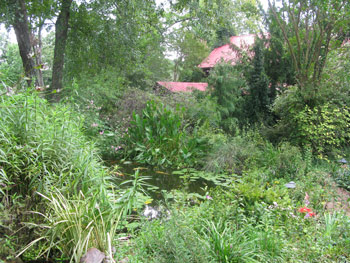
Old farmhouse rooftop provides backdrop for the koi pond at Keith Arboretum. Photo by David Swanson
I vaguely recollect back then having to water a few of Charlie’s newly planted woody specimens planted a little distance out from the old farmhouse. I also remember that Charlie’s keenness for plants possessed him rather quickly. Early on he began importing from England’s renowned Hillier’s Nursery every plant that he thought might have a chance of survival in our North Carolina Piedmont.
Well now, 40 years later, Charlie’s passion has matured to an unbelievable 25-acre arboretum of more than 4,000 labeled trees and shrubs, some common, some rare and all most interesting as an assemblage of the great diversity of the plant kingdom.
Charlie’s second wife, Muki, continues to support Charlie’s role as a plant nut.
So mark the date, Sunday, Oct. 21, 1-5 pm, to plan your visit, and check out the website (keitharboretum.org) for more information about the collection, which includes 76 species of pines, 112 species of oaks and 103 species of maples, not counting cultivars of each.

Many arboretum specimens provide year-round interest, like the bark of this Populus tomemtosa. Photo by David Swanson
Don’t miss this plant adventure!
Email Ken Moore at flora@carrborocitizen.com. Find previous Ken Moore Citizen columns at The Annotated Flora.
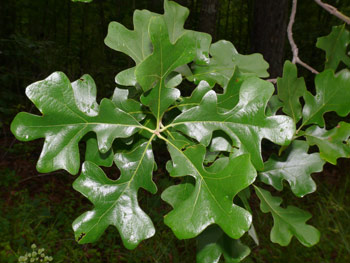
Post oak is a fairly common large tree that is typical of drier habitats. Photo by Will Cook
By Ken Moore
Flora Columnist
Editor’s Note: The following is a guest Flora column by Alan Weakley, director and curator of the UNC Herbarium.
It is hard for us not to see time through the lens of our species; humans have life spans measured in decades, at most about a century. Most other organisms with which we form close relationships have life spans shorter than we do. We have pets that live a decade or two. We plant a garden, which dies in the fall and is replanted in the spring. Perhaps we have a psychological vanity that we are nearly immortal, presiding godlike over our dependent animals and plants, watching their beginnings and ends.
However, we live our lives around organisms that live much longer than we do, that may be almost unchanged from the time of our birth to the time of our death, that stolidly oversaw events that we might consider impossibly long ago (a band of Native Americans moving along a trading path, the American Revolution, the founding of the University of North Carolina, the marriage of our great-great-great grandparents, the Civil War) and may see the 24th century. Most trees have life spans of centuries, often many centuries, and while in the eastern Piedmont we lack the “Methusaleh trees†(bald-cypresses, redwoods, sequoias, bristlecone pines) with lifespans of millenia, we still live among trees that far outlast us.
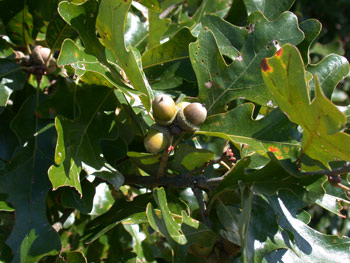
Post oak leaves with acorns. Photo by Will Cook
Undoubtedly the most famous of old trees in Carrboro-Chapel Hill is the Davie Poplar, already a notable tree in 1792 and considered to be at least 300 years old. Carolina grad though I am (’78), I can’t say that the Davie is one of my favorite old trees around town, nor is it likely the oldest. Size is a misleading indicator of age, and tulip trees (Liriodendron tulipifera) like the Davie are fast-growing, light- and soft-wooded trees – they bulk up fast, especially if pampered by ground crews and fed a rich diet of nutrients and groundwater!
Instead, consider our post oaks (Quercus stellata) common trees of the high, dry, granite monadnock of Chapel Hill. Sometimes called “iron oak,†this species is a survivor, tolerant of drought and fire and nutrient starvation. It grows slowly, often adding less than 1/16 of an inch of diameter in a year, especially when growing on a dry granite hilltop in acidic soils. Growing as little as half an inch a decade and six inches a century, post oaks develop wood that is hard and tough, the heaviest wood in North America.

Mature post oak acorns. Photo by Will Cook
Email Ken Moore at flora@carrborocitizen.com. Find previous Ken Moore Citizen columns at The Annotated Flora.
By Ken Moore

Busy-beard lichen, Usnea strigosa, is a common fruticose form found on trees. Photo by Gary Perlmutter
Lichens are pioneer plants, colonizers on boulders and other bare surfaces, slowly developing layers of soil particles for the establishment of larger plant communities. They are diverse and beautiful and frequently engage us to pause for an admiring closer look. If you’re like me, you most likely move on, wishing you knew more about lichens.
These are the times we need the company of one of those rare “lichenologists†like Gary Perlmutter, who for several years has been engaged in surveying the lichens of our Piedmont region.
I attended the one-day lichen workshop that Gary led about this time last year. It was great. He’s offering another one-day “Introduction to Lichens†coming up soon. The workshop will be held at the N.C. Botanical Garden on Saturday, Oct. 13 (ncbg.unc.edu for more information).
This is not to be missed if you are curious about lichens.
I am repeating last year’s brief and engaging description of lichens by Gary. If you missed it last year, you’ll most likely be appreciative. Otherwise, if you’re like me, a review is more than welcome.
“Just what are lichens anyway?

At least six different species of crustose, foliose or fruticose lichens are growing on this boulder surface. Photo by Gary Perlmutter
When out in the woods or even in your backyards, you often admire the trees, shrubs and wildflowers. But if you look closer on the trees, rocks and soil, you’ll see little colorful, plant-like things quietly growing on them. They may look like splotches of paint, ruffled leaves or tiny shrubs. These aren’t plants at all, but strange life forms called lichens.
Lichens are symbiotic organisms, consisting of a fungus and a photosynthetic partner living together as one. I say “photosynthetic partner†because it could be a green alga, which is a plant, or a blue-green alga, which is really a type of bacteria.

Dark squiggly lines on a holly tree trunk are common script lichens, Graphis scripta. Photo by Gary Perlmutter
Recent research has revealed the relationship is even more complicated, with entire communities of bacteria living inside lichens. Some researchers consider lichens not as individuals, but entire ecosystems in miniature.
We lichenologists use the term ‘thallus’ to describe a lichen body. To blur things further, a lichen thallus can be a single lichen or a colony of several lichens merged into one.
Generally lichens come in three growth forms or body types: ‘crustose’ (crust-like), ‘foliose’ (leaf-like) and ‘fruticose’ (shrub-like). And they come in a wide array of colors, from black to brown, to green, blue, yellow, orange, red and white. Most are a grayish-green.
Given enough time, lichens grow on just about anything. They are found on bare soil, rocks, wood, moss and even on the bark of trees, from the roots up the trunk and to the canopy branches and twigs. Some lichens grow on other lichens, crowding each other as they compete for light and space. Sometimes if you pick up a fallen branch you’ll see it’s completely covered with several different kinds of lichens – a community unto itself. In the natural world you are never far from a lichen.â€
Join Gary for his class and become the first “lichenologist†in your neighborhood.
And thank you, Gary for introducing Flora readers to the world of lichens.
Email Ken Moore at flora@carrborocitizen.com. Find previous Ken Moore Citizen columns at The Annotated Flora.
By Ken Moore
It’s time to begin gathering fruit from our native persimmon, Diospyros virginiana.
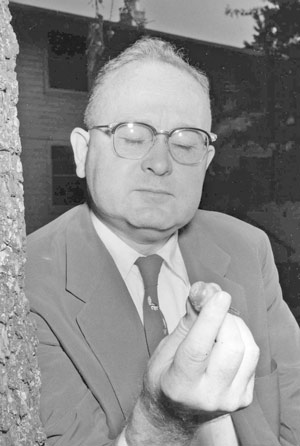
Pete Ivey contemplates a persimmon. Photo by Brian Stokes
Every year during ’simmon season, I remember “Persimmon Pete†Ivey, who for 20 years was director of the UNC News Bureau. Pete died back in 1975, and though during those years I remember folks talking about Pete’s persimmon recipes, I never met him and I’m sad about that.
And every year during ’simmon season, I also remember Roland Giduz, lifelong Chapel Hill resident, 14-year member of the Chapel Hill Board of Aldermen and longtime photographer, reporter and columnist for the Chapel Hill News Leader. When Roland died in January 2009, our towns lost a wonderful friend, a man who so enthusiastically kept the community personalities, traditions and stories alive in our consciousness.
In the late 1950s, Roland described Pete Ivey’s enthusiasm for persimmons in the old Chapel Hill News Leader. Stories of “Persimmon Pete,†the self-proclaimed “patron saint of persimmonry,†and his persimmon recipes became legendary.
You’ll enjoy reading about Pete and his persimmons, and more, in Roland Giduz’s Who’s Gonna Cover ’Em Up?!: Chapel Hill Uncovered – 1950-1985.
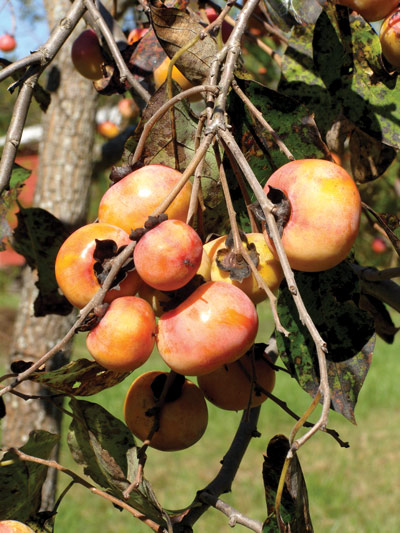
One of many fruitful persimmon trees in town and surrounding rural areas. Photo by Ken Moore
Following Pete’s death, Roland carried on the “persimmonry†tradition, going so far as to initiate a campaign to have the persimmon declared the state fruit. Sadly, not enough enthusiasts gathered around that cause. The scuppernong grape (Vitus rotundifolia) was declared the official State Fruit in 2001. But scuppernong is a vine, so it’s appropriate to pick up the torch and lobby for the persimmon to become our official State Native Fruit Tree.

A caricature of Pete Ivey drawn by Bud Brexler, director of security for N.C. Memorial Hospital, for Pete’s 20th anniversary as director of the UNC News Bureau on Sept. 1, 1975.
In the meantime, persimmons will be dropping fruit into November, so find yourself a tree and make daily visits to collect those ripened fruits from the ground before the possums and other critters beat you to it. Make certain the persimmon is ripe, soft to the touch; you’ll never put an unripened one in your mouth a second time!
Most folks use persimmons for pudding and bread recipes or beer. I prefer simply eating a ripe one as it is, and the pure pulp makes a great ice cream topping. Save the flat, long-oval, dark-brown seeds and plant them in the ground where you want your own persimmon trees. Plant several seeds some feet apart, for you need male and female trees if you want fruit.
Email Ken Moore at flora@carrborocitizen.com. Find previous Ken Moore Citizen columns at The Annotated Flora.
From roadside waif to garden star
By Ken Moore
Flora Columnist
Before I launch into this week’s Flora story, I want to describe my plans for the next couple of months.
After five-plus years sharing a “closer look†at the nature of the roadsides and forests of our own back yards, I’m taking a break for a good part of this fall.
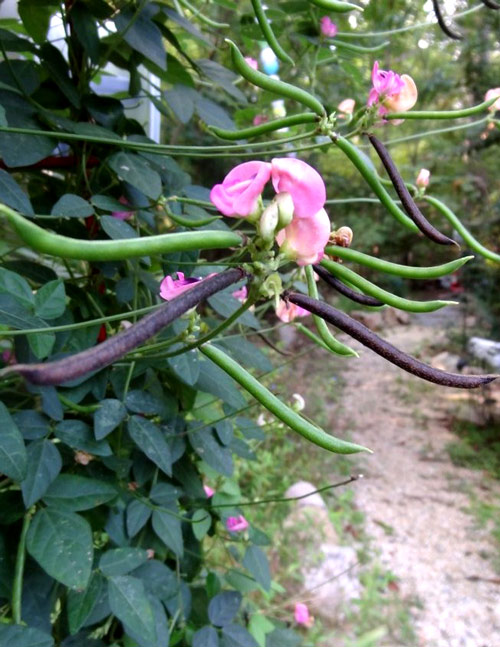
Wild bean displays flowers and fruit like a whirling ballerina. Photo by Brian Stokes
For eight weeks I’ll be co-teaching “A Closer Look at Nature†with North Carolina artist Robert Johnson at Penland School of Crafts.
I plan to contribute a couple of columns from Penland during late September through mid-November.
However, before taking leave I will have prepared a couple of stories for upcoming Floras. One is another look at our local flora through the words and paintings of Cornelia Phillips Spencer. Another column to anticipate is a description of a rare opportunity coming up on Oct. 21 to visit a nearby private arboretum of more than 4,000 labeled trees and shrubs.
During my timeout you may recognize some past Floras. Many of you will not have read them; hopefully others will appreciate revisiting seasonal themes related to the spectacular and lingering fall color of our Piedmont.

Wild bean can be a garden feature if given freedom to climb a garden trellis. Photo by Brian Stokes
One notable repeat, I promise, will be “Remembering Persimmon Pete,†and this time around Pete Ivey’s famous persimmon recipe will be included!
I think you will also be pleased to have Flora guest columns from staff of the N.C. Botanical Garden. They are every bit as passionate about the local wild plants as I am, and you folks are in for an offering of new stories and ways of taking a “closer look†at the world around us.
All that said, I now have to share with you a most amazing recent botanical experience.
The sand bean, also called wild pink bean, Strophostyles umbellata, appeared in last week’s Flora hidden within one of Cornelia Spencer’s late-summer flower bouquet portraits. This mostly unobserved little wild bean may be considered a waif of a plant along roadsides and forest edges.
Try to imagine my surprise, delight and utter disbelief when one morning last week I walked up to woods-walking friend Brian Stokes’ cottage entrance to discover a 6-foot-long trellis-fence of this native wild bean along his entrance pathway.
I was blown away! That trellis of hundreds and hundreds of pink bean flowers and beans in all stages of maturity were the result of two tiny “weedlings†rescued from his entrance drive and settled into two large containers. Brian admitted having to water those containers every day when we didn’t have ample rainfall, but they were just a few steps from his door, and what a reward from such a minimal horticultural effort.
As in Jock Lauterer’s “A Thousand Words,†no more description is required. I have urged Brian to save seed of those wild pink beans for the botanical garden’s annual members’ seed distribution.
On your next outing, perhaps you’ll discover this spectacular waif of a plant beneath your feet, and if you plant a few bean seeds, you too may produce a garden star.
Email Ken Moore at flora@carrborocitizen.com. Find previous Ken Moore Citizen columns at The Annotated Flora.
By Ken Moore
Flora Columnist

Wildflower bouquet of goldenrod, twining manroot, false foxglove and rose-pink could have been gathered along Old N.C. 86 between Calvander and Hillsborough. PAINTING PHOTO BY KEN MOORE
“Late summer woods†is Cornelia Phillips Spencer’s description, in the “Young Lady’s Column†of The N.C. Presbyterian, Oct. 8, 1873, of a late-summer walk.
Appropriate to accompany her description is the beautiful botanical fall bouquet pictured above, one of several botanical paintings of Mrs. Spencer, carefully preserved in UNC’s Southern Historical Collection.
The painted bouquet includes a stem of yellow goldenrod, Solidago, emerging through a bundle of rose-pink, Sabatia, locally common wildflowers recently featured in Flora. One may still find lingering at the base of an oak tree a yellow false foxglove, Aureolaria, which is semi-parasitic on roots of oaks. The twisting white-flowering vine is man-root, Ipomoea, clamoring over roadsides everywhere just now.
Almost 150 years ago Mrs. Spencer could have been exploring the forest edge of Old N.C. 86 to collect this lovely bouquet.

Goldenrod and Christmas fern anchor this extravagant bouquet of blue and white asters, white thoroughwort, wild oregeno, wild pink bean, wild sunflower, spiraled spikes of ladies’ tresses and leaves of sourwood and sweet gum. PAINTING PHOTO BY KEN MOORE
Spencer arrived in Chapel Hill as an infant in 1826 when her father relocated from Harlem, N.Y., to serve as chair of the university’s mathematics department. She left in 1855 as the happy bride of university graduate James Monroe Spencer to live in Clinton, Ala., until her return as a saddened widow in December 1862.
Thenceforward she directed her knowledge and passions to educating her daughter, June, and helping local residents of all walks of life. From 1870 to 1875, she badgered the state’s legislature with passionately eloquent letters until it reopened the university, which had been closed during Reconstruction.
The day proclaiming the reopening was made momentous by Cornelia Spencer, “the lady who rang the bell,†tugging on the cords of the South Building bell that had been silenced for years.
Fortunately the letters, diaries and columns written by this energetic lady about life in our region during the last quarter of the 19th century were preserved.
Her powers of verbal expression and the beauty of her paintings of our local flora are worthy of sharing here.

Cornelia Phillips Spencer loved the wild grasses and nut sedges included here as foil for exotic cultivated Macartney rose, firethorn and a bit of English ivy. PAINTING PHOTO BY KEN MOORE
“We are not as familiar with our woods now as in the spring. But just before frost has fallen on them, while summer luxuriance yet remains, though with a touch in the air that allows walking to be a pleasure for the first time in two months, they are full of beauty and full of delights. The persimmons are a light yellow, one’s mouth involuntarily screws when we look at them – black haws are yet pink – the locusts are still green – the maypops have not begun to shrivel … But, oh! The grasses and ferns and the gay fall flowers! The fall fashions and colors are as various and ever more vivid than those of spring. … There are many varieties of goldenrod. I am never tired of gathering them when they first appear, for every golden plume I see seems more enticing than the last. When the tips are yet in bud, is, on the whole, its most beautiful stage.â€
Indeed, as Mrs. Spencer described so long ago, some goldenrods have already flowered while others only now are showing a tint of gold. Go see for yourself!
[For the entirety of these descriptions, see Selected Papers of Cornelia Phillips Spencer by Louis R. Wilson, UNC Press, 1953.]
Email Ken Moore at flora@carrborocitizen.com. Find previous Ken Moore Citizen columns at The Annotated Flora.
By Ken Moore
Editor’s Note: This week’s Flora is written by guest columnist Matt Gocke, nursery and greenhouse manager at the N.C. Botanical Garden.

Black-eyed Susan blooms and southern shield fern fronds contrast nicely with one another. PHOTO B MATT GOCKE
As nursery manager at the North Carolina Botanical Garden, I periodically venture out of my containerized world and into the various habitats and landscape displays the horticultural staff have worked so hard to establish and maintain over the years. And I am constantly surprised by the amazing succession of cool blooms, leaf shapes and plant forms.

Pink blooms, purple berries and yellow spikes of obedient plant, American beautyberry and goldenrod. PHOTO BY NCBG STAFF
Though the next big spectacle in the garden will occur later this fall, there are still many native plants in bloom or fruit that warrant attention. For instance, today as I walked through the green cattail gate towards the Totten Center, I was immediately drawn to the right, where bright yellow black-eyed Susans (Rudbeckia fulgida var. fulgida) lined the grit path in front of the arching, light-green fronds of southern shield fern (Thelypteris kunthii).
Next I wandered to the entrance of the Sandhills habitat to check on one of my favorite plants, scarlet wild basil (Clinopodium coccineum). Its almost neon-red tubular blooms, similar in appearance to those of salvias, were still sporadically present. This plant has been in bloom constantly since late spring and adds a nice splash of unexpected color.
Now procrastinating, I decided to explore more on the southern side of the Totten Center and immediately stepped on a soft, slippery fruit that looked a bit like a small potato and oozed light-orange pulp. It was a ripe paw paw (Asimina triloba) fruit. Some describe the fruit as having the taste and texture of something between a mango and a banana. Everyone with enough space in their yard should grow some paw paws!
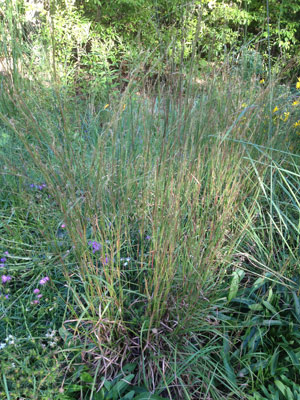
Little blue stem in the Piedmont habitat garden. PHOTO BY MATT GOCKE
Pressing on, I decided to head once again through the cattail gate and into the new Piedmont habitat garden occupying what was once part of Laurel Hill Road. There, six different species of native sunflowers (Helianthus spp.) and two species of rosinweed (Silphium spp.) branched over top with dozens of small, bright-yellow flowers. Equally grand was the mix of airy ornamental grasses, such as hair grass (Muhlenbergia capillaris) and little bluestem (Schizachyrium scoparium), with a variety of smaller herbaceous perennials blooming in shades of pink, purple and white. Species included in this floral display were obedient plant (Physostegia virginiana), scaly blazing star (Liatris squarrosa), stemless ironweed (Vernonia acaulis) and wild quinine (Parthenium integrifolium).
And then it struck me, as I found myself at the edge of the daily plant sale area on the west side of the Education Center – the fall plant sale is less than three weeks away. (See the garden’s website for details at ncbg.unc.edu). Yikes! I better get back to work!
Email Ken Moore at flora@carrborocitizen.com. Find previous Ken Moore Citizen columns at The Annotated Flora.
By Ken Moore
Flora Columnist
I love the new landscaping around the three buildings of the N.C. Botanical Garden’s visitor education center. Garden staff are committed to planting that new landscape with native species that occur in Orange or adjacent counties. That means that all the specimen plants and sweeps of plants that are there are species of plants that we would find growing along roadsides and in local fields and forests.

Nature planted the beautiful dwarf partridge pea ground cover for the botanical garden entrance sign. PHOTO BY KEN MOORE
That landscape of local wild plants overflows along the parking area and onto the adjacent roadside and forest edges. Every day I visit I am impressed by how so many taken-for-granted and often-considered weed natives, like poke and dog fennel, become beautiful garden specimens or appealing masses when taken out of their wild context.
Not only do staff curators Amanda Mixon, Chris Liloia and Sally Heiney deliberately place these locally wild subjects, they judiciously and selectively let thrive many plants placed by nature’s wisdom.
Such is the planting of the emerald-green ground cover from which the botanical garden’s entrance sign seems to arise as from a green cloud. A sweep of a sensitive plant, Cassia* nictitans, a common field annual in the pea family, was carefully sown around that sign by nature.
Of course, that natural planting is not completely maintenance-free – nothing is. To achieve various effects here and there, nature’s exuberance does require massaging from time to time. According to Sally, the keeper of the entrance-sign roadside, she has “edited†(Sally’s honorary title for her weekly weeding volunteers is the Landscape Editors) the area, but just occasionally this entire season.
I prefer to call this lush green ground cover dwarf partridge pea because it is a diminutive cousin of larger, closely related partridge pea, Cassia fasciculata.

Flowers of common partridge pea are large enough to be showy. PHOTO BY KEN MOORE
The flattened bean pods of both species contain seeds that are a favorite food for bobwhite quail, of which we have way too few. The pinnately compound, fern-like foliage is sometimes browsed by deer, of which we have way too many. This valuable native plant of fields and other disturbed sites also serves as a larval host for several butterfly species.
The larger partridge pea is showing off now in some of the fields of Mason Farm, though not as spectacularly as in some past years. Typical of annuals, population size varies from year to year, depending upon natural invasion by perennial plants and/or lack of natural or human-caused disturbances.
Most likely that superb dwarf partridge pea ground cover at the garden entrance won’t be quite so exuberant next year. Gardening with nature is like that – no two years are ever the same!

You have to take a very close look to see the flowers of dwarf partridge pea. PHOTO BY KEN MOORE
During the next couple of weeks you can take a closer look at both partridge peas at the botanical garden entrance drive – the dwarf is on the right, beneath the sign, and the big one is on the left along the footpath.
And thank you, Mixon, Chris and Sally for bringing so many of our local natives up close for our appreciation.
There are so many unusual local natives newly displayed around the visitor center that I am hoping to have nursery manager Matt Gocke describe more of them in Flora next week.
*For the taxonomic purist, Cassia is now officially Chamaecrista.
Email Ken Moore at flora@carrborocitizen.com. Find previous Ken Moore Citizen columns at The Annotated Flora.